

Cigar Storage on the Go: Because Your Sticks Deserve Better Than a Ziplock Bag
A Beyond the Humidor Guide for the Traveling Aficionado

So you've got a trip coming up. Maybe it's a business conference, a golf weekend, a wedding you'd rather not be at, or a cigar festival that's absolutely worth every penny of that airline ticket.
Whatever the occasion, one thing is non-negotiable: your cigars are coming with you. The question is — are you going to treat them like the handcrafted, hand-rolled, lovingly aged works of art they are, or are you going to throw them in a sandwich bag next to your deodorant and pray for the best?
We thought so. Let's do this right.
Portable Humidors: Your Cigar's Best Travel Companion
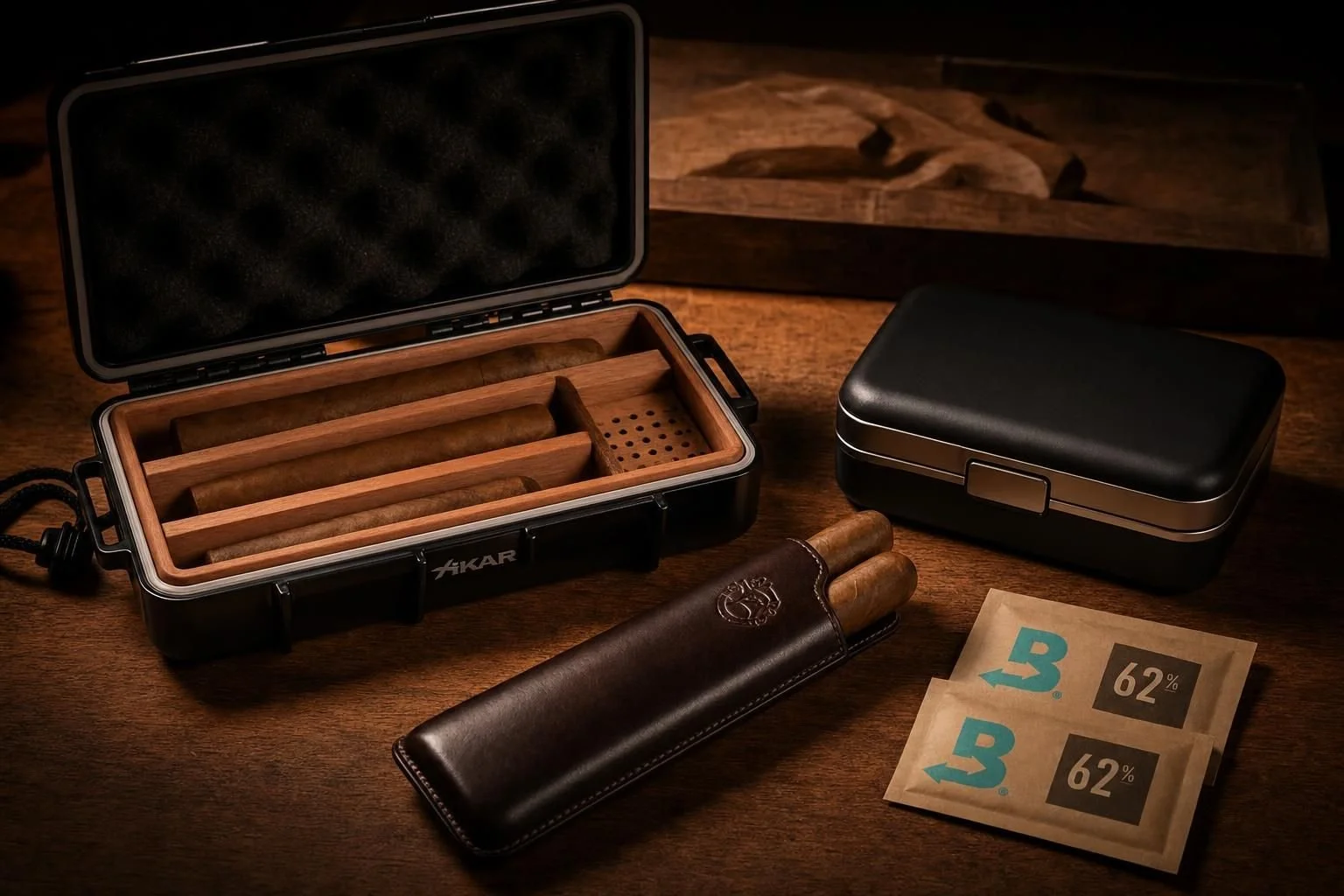
Let's start with the foundation of any smart travel setup — the portable humidor. This isn't optional, folks. It's not a luxury. It's basic respect for the leaf.
Portable humidors come in a wide range of styles, sizes, and price points, so there's really no excuse for roughing it:
Travel Cases (Hard-Sided)
These are your workhorses. Brands like Xikar, Pelican, and Adorini make hard-sided cases with foam inserts, Spanish cedar lining, and solid seals that keep humidity stable during short to medium trips. They typically hold 5–10 cigars comfortably. Think of them as the carry-on of the cigar world — compact, efficient, and purpose-built.
Soft-Sided Leather Cases
For the aficionado who values aesthetics as much as function, leather travel cases offer a more refined look. They won't maintain humidity as effectively for longer hauls, but for a 2–3 day trip, a good leather case with a small humidity pack tucked inside does the job beautifully. Plus, you'll look like you mean business at the hotel bar.
Boveda Travel Humidors
If you haven't yet fallen head over heels for Boveda packs, consider this your intervention. These two-way humidity control packets are a traveler's best friend. Throw a 62% or 65% Boveda pack into almost any sealed container — your travel case, a dedicated Boveda travel humidor, or a cigar-safe Tupperware setup — and you've got a functional portable humidor. It's not glamorous, but it absolutely works. The Boveda Cedar Spill is a particularly elegant solution for this exact use case.
What to Look For
A tight seal — if air gets in, humidity gets out. Simple physics.
Spanish cedar lining — it absorbs and releases moisture and repels tobacco beetles (yes, that's a real thing and yes, it's exactly as horrifying as it sounds).
The right size — pack what you need, not your entire collection. Be realistic.
Pro tip: Condition your travel humidor before the trip. Don't just toss in your sticks and go. Run a humidity pack in the sealed case for 24–48 hours, check the environment, then load it up. You're welcome.
Ideal Cigars for Travel: Choose Wisely, Smoke Well
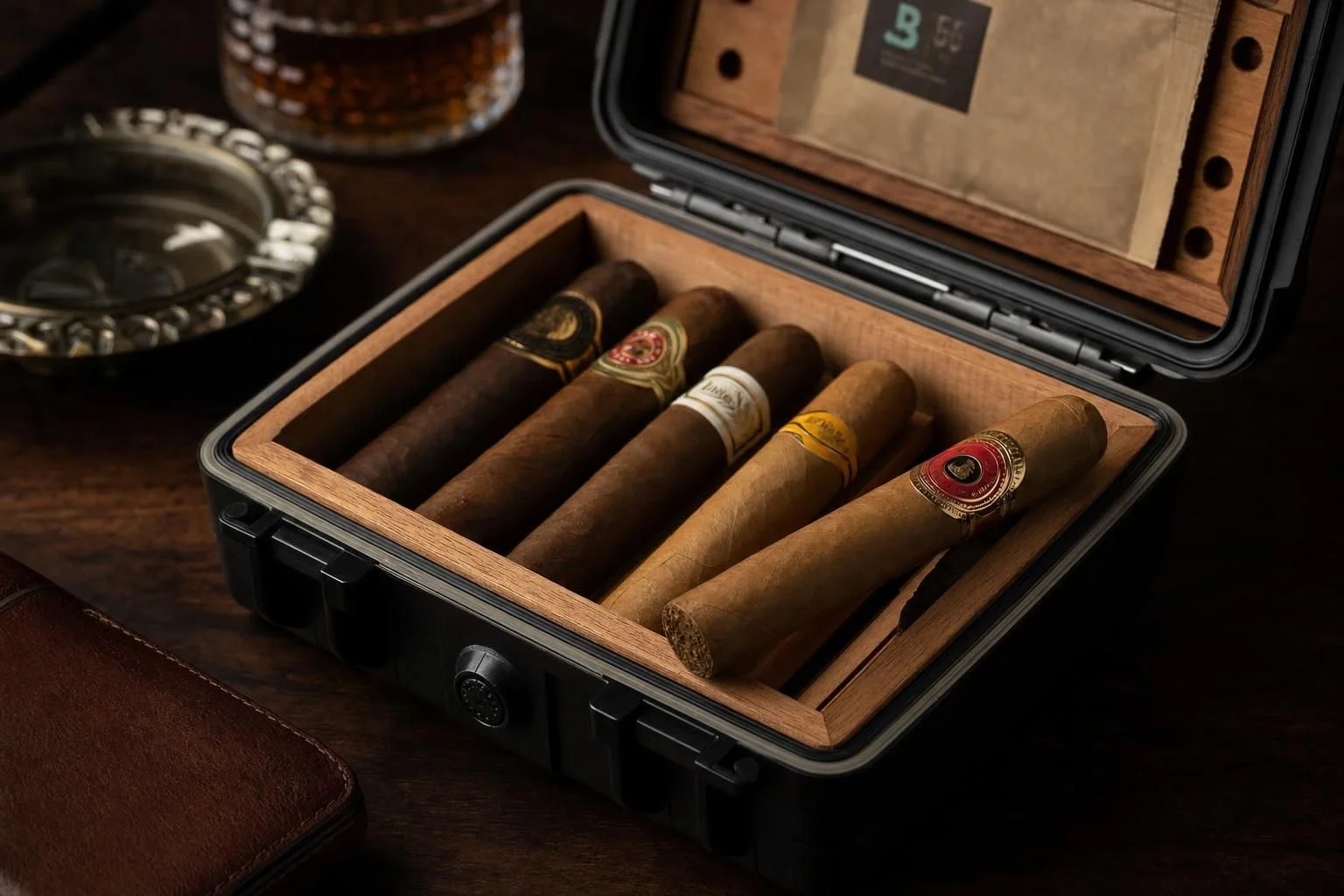
Not all cigars are created equal when it comes to travel, and selecting the right sticks for the road is as important as packing them correctly.
Durability Matters
Look for cigars with medium to firm construction. Softer, more delicate cigars — especially those with oily wrappers — are more susceptible to damage from pressure changes, jostling, and temperature fluctuations. If you're bringing something precious, protect it accordingly.
Size Considerations
Traveling with a box of 60-ring Churchills? Bold move. Consider that shorter formats — Robustos, Coronas, Petite Coronas — are easier to transport, fit more efficiently in a travel case, and can be enjoyed in a shorter window of time (useful when you're on a tight schedule between meetings or tee times).
Tried and True Road Warriors
Some cigars are just built for adventure. Here are a few that consistently earn their frequent flyer miles:
Arturo Fuente Hemingway Short Story — compact, complex, and devastatingly good in any zip code
Perdomo 10th Anniversary — robust, reliable, travels like a champ
Padron 1964 Anniversary Series Robusto — because sometimes you deserve the best, even at 35,000 feet
Rocky Patel Vintage 1992 — a personal favorite of the Beyond the Humidor family, and for very good reason
Oliva Serie V Melanio — exceptional build quality and flavor depth that holds up even after a rough bag check
Leave the Fragile Stuff at Home
You know that Connecticut shade single-source limited edition you've been cellaring since 2019? Leave it. Travel is for workhorses. Save the unicorns for the home humidor.
Airline Rules & Care: Navigating the Friendly (and Occasionally Hostile) Skies
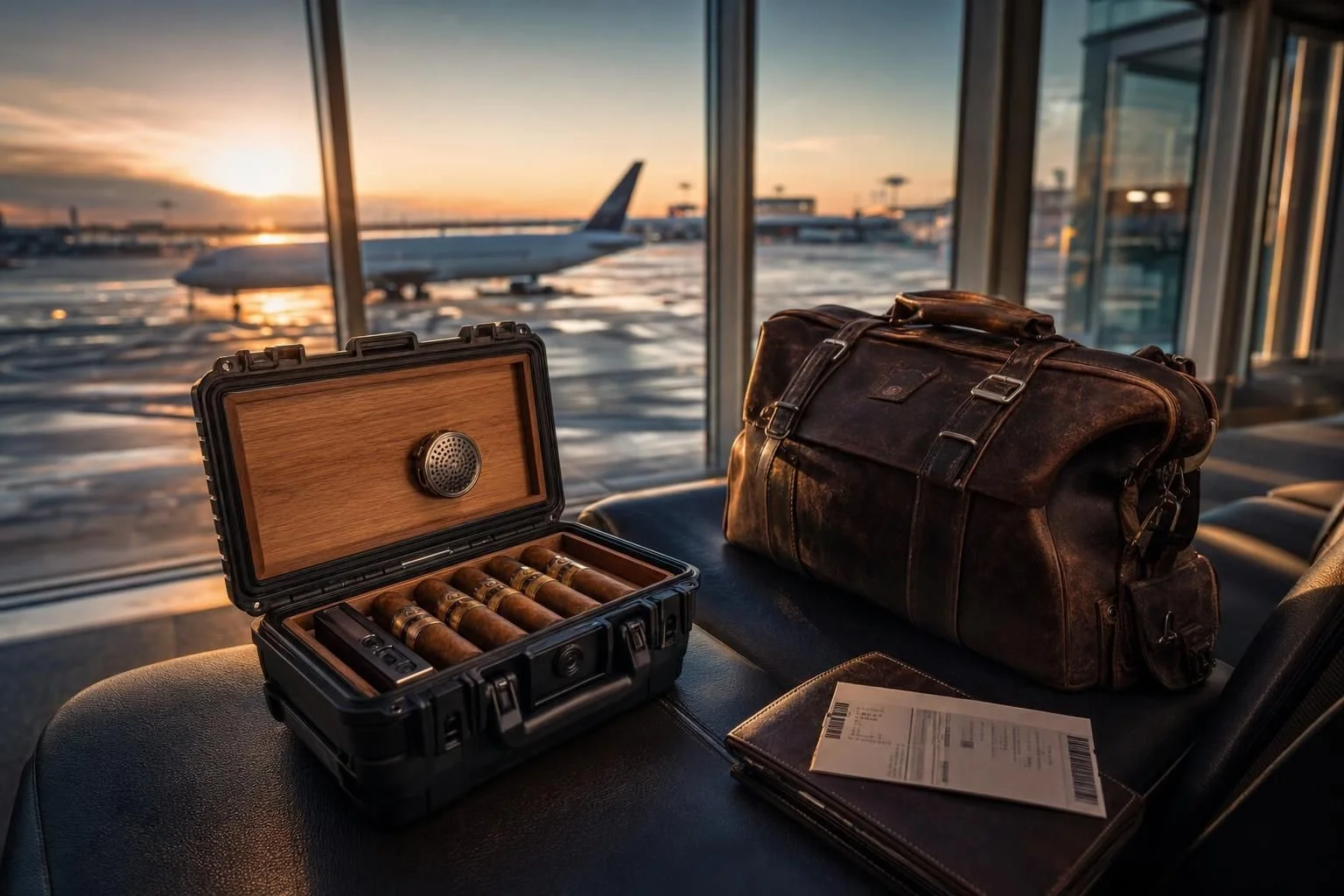
Here's where it gets interesting. Flying with cigars is absolutely doable — people do it every single day — but it requires a little know-how and a healthy respect for the fact that regulations can and do change. So let's get into it.
Carry-On vs. Checked Luggage
The good news: cigars are permitted in both carry-on and checked luggage by the TSA. There is no federal prohibition on flying with cigars. You can breathe easy — just not smoke easy. Not yet. That comes later.
The better news: carrying your cigars in your carry-on bag is almost always the smarter move. Checked luggage gets thrown, stacked, sat on, frozen at altitude, and generally subjected to conditions that would make a tobacco farmer weep. Your carry-on stays closer to cabin pressure and temperature, which is far more hospitable for your sticks.
How Many Can You Bring?
For domestic U.S. flights, there is no legal limit on the quantity of cigars you can transport. For international travel, however, it gets nuanced. Customs regulations vary by country, and the U.S. Customs and Border Protection (CBP) has duty-free allowances that cap out at 100 cigars brought back into the United States from abroad (with some exceptions for Cuban cigars, which are now technically permitted up to $800 worth for personal use — but don't make us explain that entire saga right now).
If you're returning from a trip to Nicaragua, Honduras, the Dominican Republic, or anywhere else you've been shopping the source like the serious aficionado you are, declare everything, know the thresholds, and don't play games with customs agents. They've seen it all.
Flying With Lighters: A Special Kind of Bureaucratic Adventure
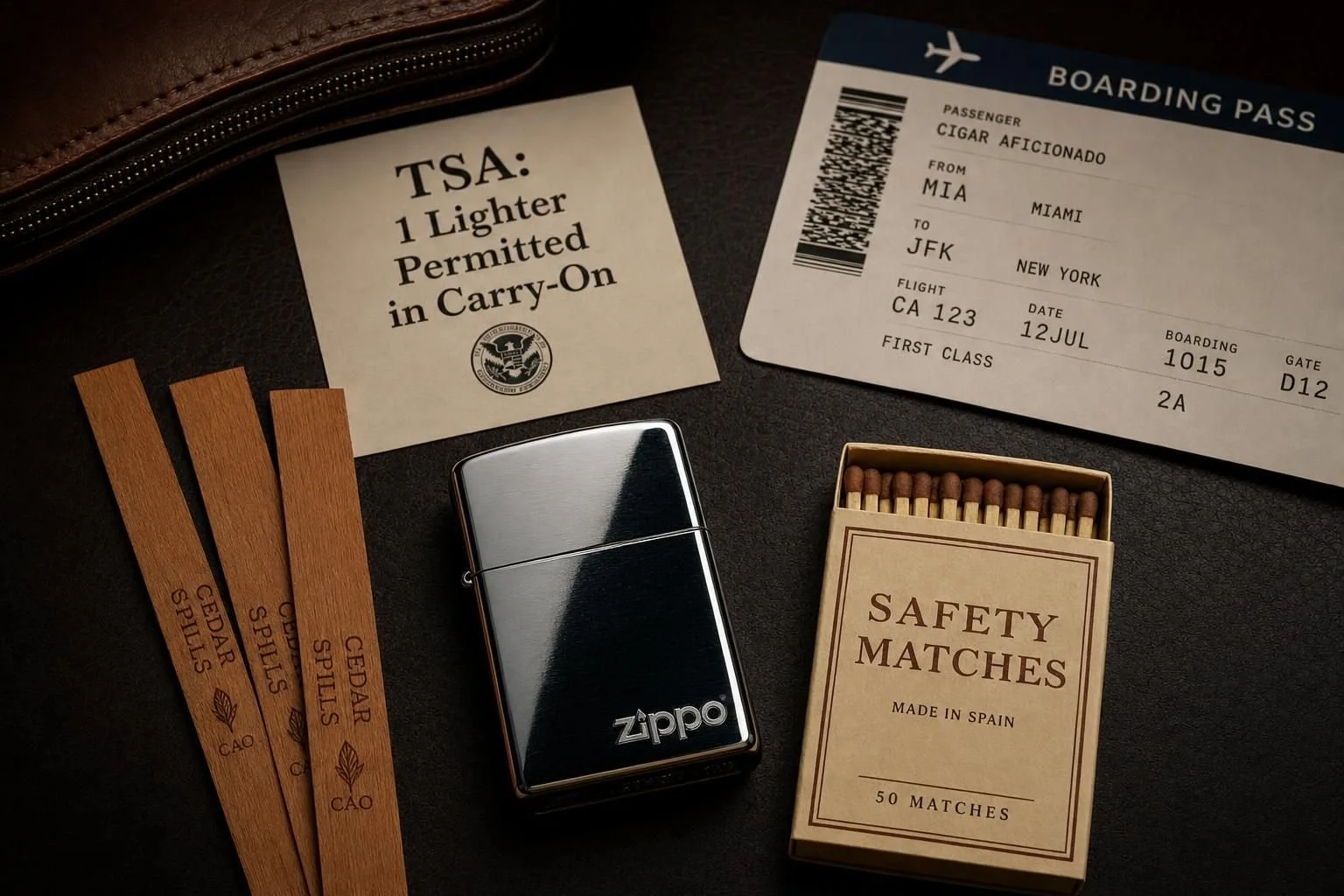
Ah yes. The lighter. That small, seemingly innocent device that has caused more airport confusion than any other item in the cigar smoker's kit. Let's clear the air (pun absolutely intended).
What TSA Actually Says
According to the Transportation Security Administration (TSA), here is the current rule:
One common lighter (disposable or Zippo-style) is allowed in your carry-on bag or on your person. It is NOT permitted in checked luggage (unless stored in a DOT-approved case).
That's it. One lighter. In your carry-on or in your pocket. Not your checked bag (unless it's in a DOT-approved case, which almost nobody actually uses).
What About Torch Lighters?
And here's where the cigar smoker gets the short end of the stick — torch lighters (butane jet lighters) are prohibited in both carry-on and checked bags. Full stop. The TSA is not interested in your triple-flame Xikar or your beloved Colibri. Not on the plane.
This is, objectively, one of the more frustrating regulations in modern air travel. Your torch lighter that you use responsibly, respectfully, and exclusively on fine cigars is treated with the same suspicion as... well, we'll leave that alone.
Matches?
Yes — one book of safety matches is allowed in carry-on. Strikes-anywhere matches? Prohibited. (Because apparently safety is only allowed up to a point.)
The Cedar Spill Option
This is actually the most civilized solution to the travel lighting problem. Pack cedar spills — thin strips of Spanish cedar — as your ignition source. They're TSA-friendly, they enhance the flavor of the cold draw, and they make you look like you really know what you're doing. Which, if you're reading this, you do.
Always, Always Check With Your Airline
Here is the part where we have to be the responsible adults in the room: TSA rules and airline rules are not the same thing. TSA governs what goes through security. Your airline governs what goes on the plane. And international airports operate under their own sets of rules entirely.
Before every trip, check directly with your airline for their current policies on lighters and tobacco products. Policies change, enforcement varies, and the last thing you want is to surrender your favorite lighter at the gate because you assumed the rules hadn't changed since your last flight.
This isn't us being overly cautious — it's us having heard enough travel horror stories from fellow aficionados to know that "I thought it was fine" is not a defense that gets your lighter back.
Caring for Your Cigars Mid-Journey
The trip itself presents a few additional challenges worth addressing:
Temperature swings are the enemy. Airplane cabins, hotel rooms with aggressive AC, car trunks in July, and outdoor venues in the desert can all wreak havoc on your sticks. Keep your travel case insulated and away from direct heat or cold sources.
Humidity equilibration takes time. If your cigars went through a rough transit, give them 24–48 hours to rest and re-acclimate before smoking. You wouldn't expect a world-class athlete to perform 20 minutes after a red-eye flight. Same principle applies.
Don't over-humidify on the road. The instinct when traveling is to throw in extra humidity sources "just in case." Resist it. Over-humidified cigars smoke hot, harsh, and draw poorly. Trust your Boveda pack and leave it alone.
The Bottom Line
Traveling with cigars doesn't have to be complicated — it just requires a bit of preparation, the right gear, and the common sense to check your regulations before you fly. The aficionado who shows up at a destination with well-conditioned sticks, a quality cutter, and a cedar spill is the aficionado who smokes well. The one who threw three cigars into a gym bag and forgot about them is the one bumming lights and crying into a gas station cigarillo.
Be the first person.
This post was brought to you by the good folks at Beyond the Humidor — your home for everything cigar culture, industry insights, and the kind of conversation you can only have with a great stick in hand. Subscribe to the podcast, join the Beyond the Humidor Nation, and travel well.
Have a travel tip, a horror story, or a lighter recommendation we missed? Drop it in the comments or hit us up on social. We read everything.
