


There is a sound a good evening makes, and it isn't loud. It's the cicadas clocking out. It's the neighbor's leaf blower finally surrendering. It's the patio light humming like a tiny, optimistic fluorescent tube while the screen door sighs shut behind you. That's the cue. That's when I wander out to the back yard, a modest rectangle of lawn, concrete, and one stubbornly lopsided citrus tree that I have christened The Oasis. (First rule of any retreat: give it a name that sounds like it has a cover charge and a two-drink minimum.)
Nobody needs a reason to sit in their own yard. I know this. And yet I always arrive carrying one, like a customs declaration. Tonight, I am personally verifying that the motion-sensor floodlight still detects motion. Last Tuesday it was a rigorous audit of the hose reel. Before that, I was "listening for a raccoon." I have never once heard a raccoon. I have heard crickets, a distant sprinkler system, and the deeply restorative sound of nobody asking me where the tape measure went.
Here is what all those official inspections have taught me: the cigar is only half of the experience. The other half is everything that touches it, lights it, shelters it, and holds it while you take your hands off to adjust a chair cushion. Get that half right and a decent cigar becomes a memorable evening. Get it wrong and even an excellent cigar turns into a small, smoky argument with your own equipment.
So this post is about the gear. Specifically, it's about which pieces deserve your hard-earned money, which ones deserve a polite pass, and how to tell the difference when a glowing display case is whispering "you've earned this" in the voice of an overly confident game show host.
If you grew up recording songs off the radio while praying the DJ wouldn't talk over the intro, you already know that a cheap cassette eats your favorite song. Some of us are still applying that lesson.
The Quick Rule Before We Dive In
If you only read one paragraph of this post (and I respect your time, because I have clearly not respected my own), make it this one:
Splurge on anything that touches the flame, the blade, or the climate. Save on anything that merely holds, props, or decorates.
That's the whole philosophy in two sentences. The rest of this article is me proving it, adding examples, and sneaking in a few jokes about patio furniture.
I think of these as the Three Zones: Flame, Blade, and Climate. Your lighter lives in the Flame zone. Your cutter lives in the Blade zone. Your humidor and its humidity gear live in the Climate zone. Every one of those can make or break the cigar in your hand, and every one of them is a place where the cheap version quietly sabotages you. Everything outside those zones, like ashtrays, stands, and travel cases, can be wonderful, but a bargain version rarely ruins your evening.
Keep those three zones in your back pocket. We're going to keep coming back to them.
Quality vs. Affordability: The Math Nobody Does at the Register
Let's start with an uncomfortable truth: "affordable" and "cheap" are not the same word, even though they've been carpooling for years.
Affordable means the price fits your life. Cheap means the price is the only thing it has going for it. A fair number of cigar accessories live in that second category, sitting in bins near the checkout counter wearing a tag that says $9.99 and a smile that says "I'll let you down in about three weeks."
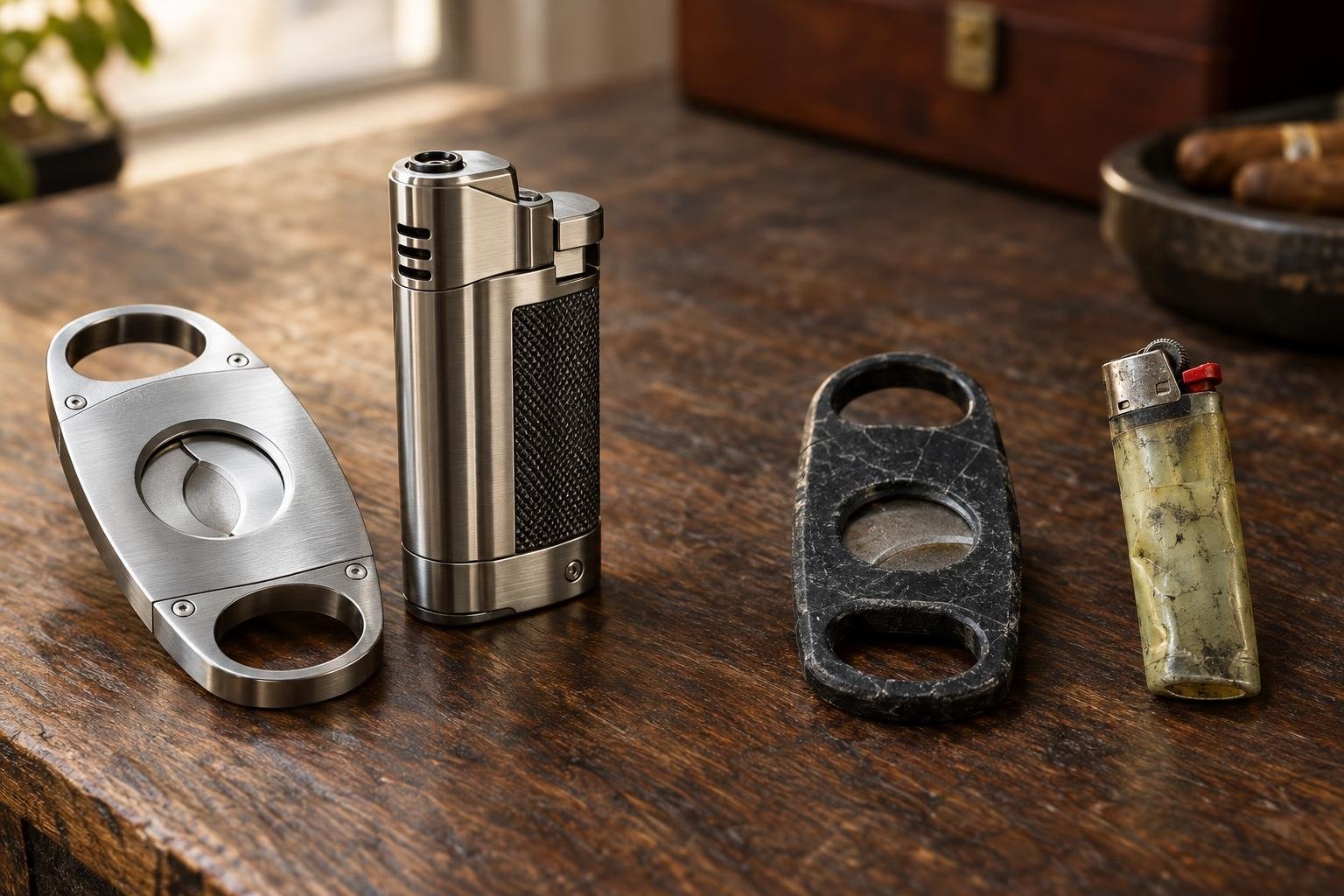
The tricky part is that the cheap option almost always feels like the responsible one in the moment. You're being frugal. You're being sensible. You're not the type of person who spends triple digits on a device whose entire job is to remove the end of a cigar. I admire that restraint. I also admire the person who buys the bargain umbrella on the way into a thunderstorm. We both end up wet; one of us just has a flimsier story.
The Cost-Per-Use Test
Here's a trick that has saved me from more impulse purchases (and more guilt-laden regrets) than any budgeting app: divide the price by the number of times you'll actually use the thing.
Take a good cutter. Say you smoke three cigars a week, which is a generous allowance of Oasis time but not an outrageous one. That's about 150 cuts a year. A well-made cutter with a proper blade can easily last fifteen years or more, which works out to over 2,200 cuts. Even if you paid a serious chunk of money for it, you're looking at a few cents per cut.
Now picture the bargain cutter. It dulls in a season. The blades start to pinch instead of slice. You replace it every year or two, and over those same fifteen years you've bought it half a dozen times, plus you've spent that entire stretch tearing wrappers and cursing at a small piece of stamped metal. These are round, illustrative numbers, not an audit, but the pattern holds for nearly every piece of gear on this list: the "expensive" item is often the cheaper one once you stop looking at the price tag and start looking at the calendar.
The Cost of Regret
There's a second ledger most of us forget to keep, and it's the one that tracks spoiled cigars.
A cigar you've been aging for months is not a throwaway item. A fresh, well-kept cigar might run you ten, fifteen, twenty dollars or more. If a dull blade tears the wrapper on one of those, you've effectively paid for a nicer cutter in a single bad snip. If a leaky humidor lets an entire box dry out into something resembling kindling, you haven't saved money; you've funded a very expensive science experiment about evaporation.
The splurge is often an insurance policy for the part of the hobby you actually care about. You're not buying the accessory. You're protecting the cigars and the quiet half hour you carved out to enjoy them.
Expensive Is Not Automatically Good
A big price tag does not equal quality. Price can be a loudspeaker for marketing, a fancy logo, or a boutique showroom with its own playlist. I have held very expensive accessories that felt assembled from a dream, and modest ones so well finished I wanted to apologize for the price. Quality is a set of behaviors: it does the same thing, the same way, every time. Spend money on behavior, not branding.
A Simple Three-Tier System
To keep myself from either overspending or becoming the person who lectures a gas station clerk about steel, I sort gear into three tiers:
Tier One: Buy the best you can reasonably justify. These are the Flame, Blade, and Climate items: the lighter, the cutter, the humidor, and the humidity control inside it. They directly affect how a cigar draws, burns, and tastes. This is where the splurge lives.
Tier Two: Buy good, not great. Ashtrays, travel cases, and humidity monitors. They matter, they should be well made, but you don't need the museum edition. A solid mid-range pick will serve you for years.
Tier Three: Don't overthink it. Cedar spills, simple cigar rests, a cheap backup cutter in the glove box. Cheap is fine here.
The Gift Set Trap
A word about the pre-packaged "starter set." You know the one: a cutter, a lighter, and a little ashtray nested in a cardboard box with a ribbon, priced at a number that sounds like it was chosen by a committee that never smoked. It's the junk drawer of the cigar world. Three items, none of which you'd have picked on their own, all of which were chosen to hit a price point instead of a standard.
A gift set is a nice gesture and a lousy strategy. If you're buying for yourself, buy the pieces one at a time and buy them right. If you're buying for someone else, one genuinely good item beats a bundle of three forgettable ones every day of the week, including Sundays and the weeks with a holiday in them.
Okay. Philosophy delivered. Let's talk about what separates a well-built accessory from one that merely looks like it was.
Craftsmanship Standards: How to Tell Well-Made From Well-Marketed
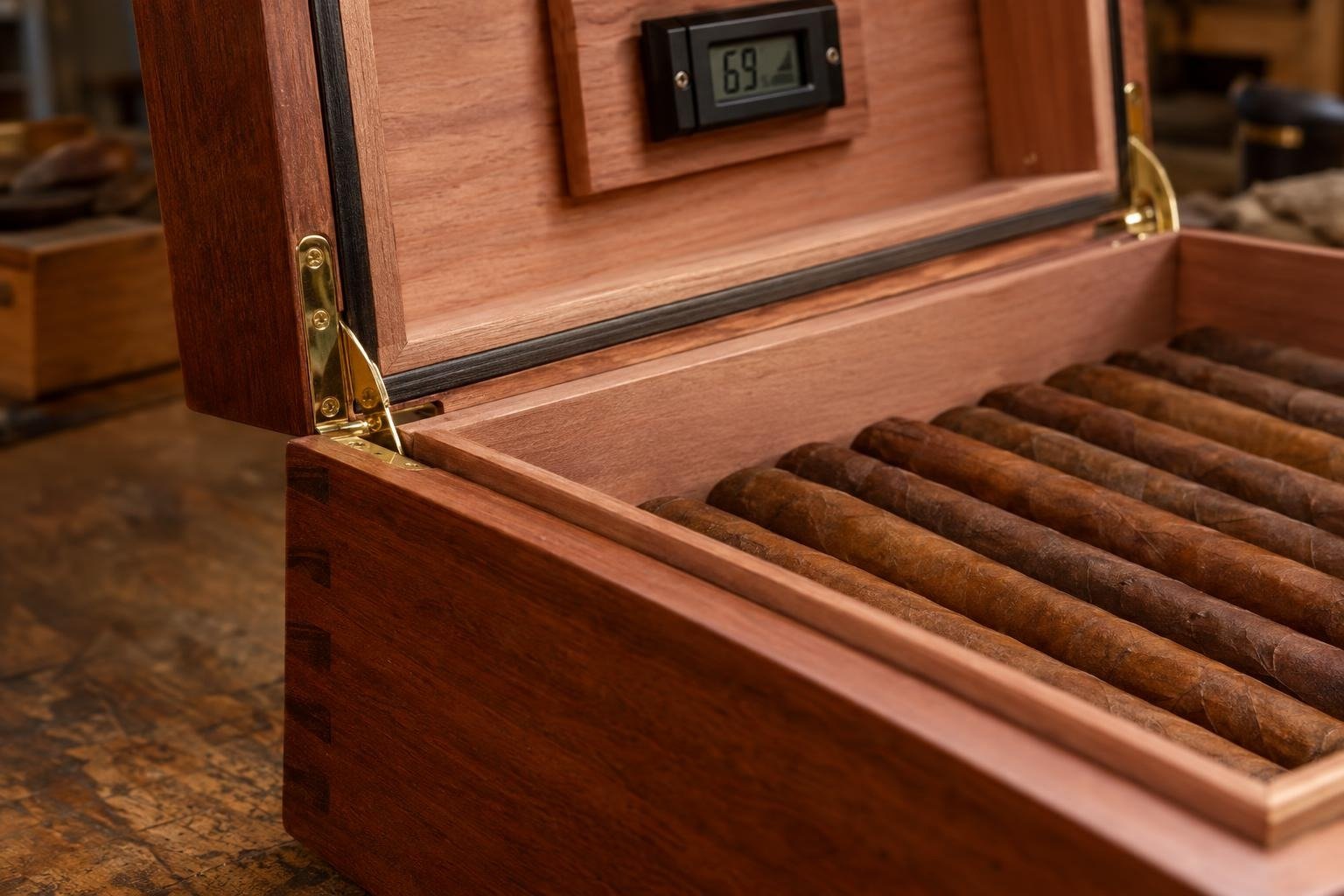
Craftsmanship sounds like one of those words reserved for a documentary about a guy who builds violins in a mountain cabin. But in the cigar world, it has a practical, checkable meaning. You don't need a jeweler's loupe or a degree in metallurgy. You need your hands, your ears, and a willingness to look slightly odd in a shop while you open and close a lid fourteen times.
Start With the Hands
The best test of any accessory is the one you can do in five seconds without a single tool: pick it up.
Weight tells a story. Good materials usually carry a reassuring heft. A cutter that feels like a toy tends to be a toy. A lighter with a hollow, rattly body is usually hiding thin metal and a bargain mechanism. Weight alone isn't proof of quality (a brick is heavy, and nobody's calling it a masterpiece), but when an item is suspiciously light for its size, ask why.
Listen to the moving parts. A good lid closes with the soft, confident sound of a well-hung door settling into its frame. A cheap one clacks, wobbles, or hovers a hair's width off the box like it's not sure it wants to commit. A hinge should move with even, quiet resistance, no grinding, no sideways play. If the mechanism feels like it's rehearsing its eventual failure, believe it.
Check the tolerances. Tolerance is the jargon for how closely the parts fit together. A well-built accessory has gaps so tight and consistent that they look painted on. Think of a well-built dry stone wall: no mortar, no glue, and everything stays put because every piece was chosen and placed with care. A poorly built accessory has the opposite look: uneven seams, a lid that fits on one corner and gaps on the other, a blade that rubs against its housing like two strangers on a crowded bus.
Materials That Matter (and Ones That Just Sound Fancy)
Every category has its own version of "the good stuff," and a few red-flag words that mean less than they promise.
Steel. For cutters, you want hardened stainless steel that holds an edge. Words like "surgical grade" and "premium alloy" are decoration unless the maker can tell you what the steel actually is. A sharp blade should glide through a cigar cap like a skate through fresh ice and leave a clean, smooth surface behind. A dull one crushes the cap, and the damage often shows up later as a cracked wrapper or a draw that fights you the entire way down.
Cedar. A proper humidor should be lined with Spanish cedar, a wood that absorbs and releases moisture evenly and carries a pleasant, faintly resinous scent. Be wary of boxes that are cedar veneered in a razor-thin layer or only lined on the lid. A thorough lining means cedar on every interior surface, including the bottom and the dividers, with no exposed particleboard peeking out from the corners.
Finishes. Lacquer, leather, and veneer should look like they were applied by someone who cared. Bubbles, drips, and uneven coloring are the hallmarks of a rushed job. Hand-stitched leather has tight, even stitches that march in a straight line like a well-rehearsed marching band. Glued-on "leather-look" vinyl peels at the edges like a sunburn.
Fuel systems. For lighters, the guts matter as much as the shell. A quality lighter uses a refined valve system that lets you refill it cleanly, and it holds its fuel instead of slowly leaking out in your jacket pocket. A transparent fuel window is a small feature with a big payoff: you'll know it's running low before it quits on you mid-evening.
Why Craftsmanship Shows Up in the Smoke
This may sound like I'm being precious about metal and wood, but craftsmanship has a direct, practical effect on the three things we all care about: the draw, the burn, and the ash.
The draw. A clean cut from a sharp blade opens the cap smoothly and keeps the end of the cigar intact. A good draw feels like breathing through a clean snorkel: steady, unrestricted, and quietly satisfying. A bad cut, from a dull or poorly aligned blade, is more like trying to inhale through a couch cushion. Same cigar, same evening, wildly different outcome.
The burn. An even, steady burn depends in part on a cigar that was stored correctly and lit gently. A well-made lighter delivers a consistent flame you can control, while a flimsy one sputters, flares, or goes out at the first hint of a breeze. Think of the difference between a reliable old truck that starts on the first turn of the key on a cold morning and a mower that makes you pull the cord until your shoulder files a grievance.
The ash. A firm, tightly packed ash is a sign of a well-built cigar, but it's also a sign of a cigar that has been kept in proper conditions and handled with care. A solid gray column that clings on like snow on a pine bough, layer after layer, tells you the humidity was right, the burn was even, and nobody rushed the process. A flaky, crumbling ash that collapses into your lap is the cigar equivalent of a stack of cards in a stiff wind. Good gear gives you the best possible shot at the first kind.
Serviceability: The Quiet Mark of Quality
Here's a craftsmanship signal almost nobody checks: can it be fixed?
A well-made accessory is built with the expectation that it will be maintained. The blade on a good cutter can be sharpened or replaced. A quality lighter can be serviced, with a replaceable flint or ignition piece. A humidor's seal can be adjusted, its hinges tightened, its humidifier swapped. Throwaway items are built to be thrown away. Items made to be repaired tell you the maker is confident they'll still be around when you need that repair.
The same goes for warranties. A meaningful one, covering real defects over a real stretch of time and actually honored, is among the best signs a product was built with pride. A warranty that expires after thirty days is just a countdown timer.
The Pocket Checklist
When you're in a shop (or staring at a product page at an hour you'd rather not admit), run through these quick checks:
Does it feel solid for its size? Light and rattly is a warning.
Do moving parts operate smoothly and quietly? No grinding, no wobble, no mystery slack.
Are the gaps tight and even? Lids, hinges, and blade housings should fit like they've been introduced.
Is the finish clean? Look for drips, bubbles, uneven edges, and rough seams.
Can it be serviced or repaired? Replaceable blades, refillable fuel, swappable parts.
Is the warranty real? Long, clear, and easy to understand beats short and vague.
Do the materials match the claims? If it says cedar, check for cedar everywhere.
If an item passes six of those seven, it's probably worth keeping. If it passes three, put it back. Nobody has ever regretted leaving a mediocre accessory on the shelf.
The Essential Gear List
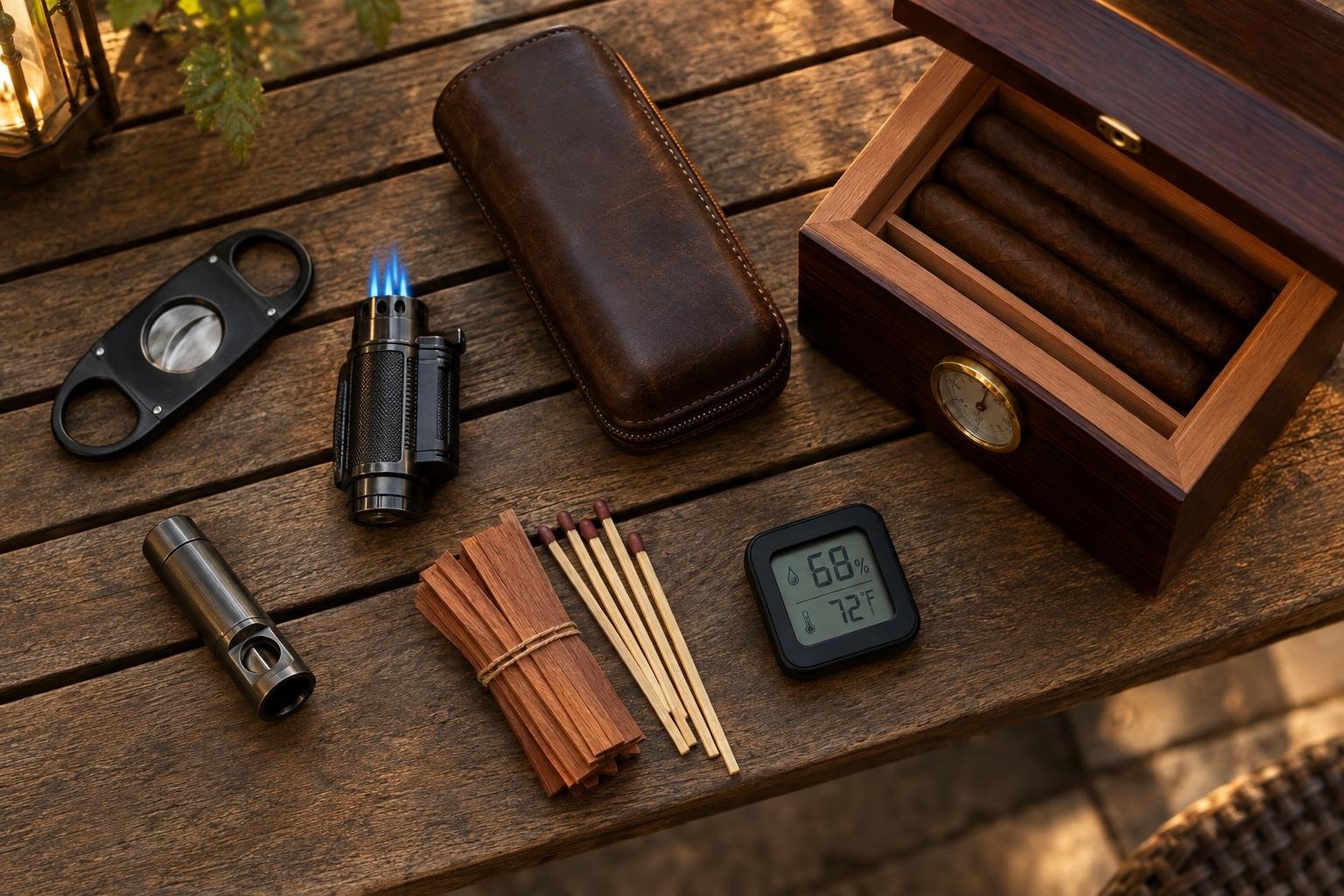
Alright, here's the part you scrolled down for. I've organized this list by the Three Zones plus a few supporting players, and each entry gets a "splurge verdict" so you know where the money goes. Prices vary wildly by region and retailer, so I'm talking in tiers rather than dollar amounts.
1. The Cutter (Blade Zone)
Splurge verdict: Yes. Absolutely. Do not pass Go.
The cutter is the first tool to touch the cigar, and it makes the first decision about how the whole experience will go. A clean, quick cut opens the cap without tearing the wrapper and sets up a smooth, even draw. A bad cut can crack the wrapper, leave a ragged opening, or squeeze the head so tight the draw feels like a clogged garden hose.
What to look for:
Sharp, hardened blades that glide through the cap in one motion. If you have to saw, it's not sharp enough.
Double-blade design (a double guillotine) for a balanced cut that doesn't push the cap sideways.
A smooth, firm action with a spring that snaps open and closed without grit or wobble.
Opening size to match your cigars. Many modern cigars are fat, so check that the opening handles larger ring gauges without forcing you to guess.
Replaceable or sharpenable blades, because a cutter you can maintain is a cutter you'll keep.
Where the money goes: The steel and the assembly. You're paying for a blade that stays sharp and a mechanism that doesn't loosen over time. A cutter that holds its edge for a decade is one of the better returns on investment you'll find in any hobby.
Backyard tip: Keep it in the same spot every time. Nothing ruins the mood faster than a ten-minute search of the patio with a flashlight, when it turns out the cutter was in the cup holder all along, quietly judging you.
2. The Lighter (Flame Zone)
Splurge verdict: Yes, and this is the one people underestimate.
Lighting a cigar is a slow, gentle art. You want to toast the foot, warming it evenly before you take your first draw, not blasting it like you're stripping paint off a porch rail. The goal is to get an even light without scorching the wrapper, and a good lighter makes that easy.
What to look for:
A butane torch flame, ideally one with multiple jets. Wind in a back yard is a given, and a flame that stays steady in a stiff breeze is worth its weight in gold.
An adjustable flame so you can dial it up for a breezy night or down for gentle toasting.
A solid, reliable ignition that fires on the first click, not the fifth. Lighters that need coaxing are no better than a damp match.
A visible fuel window so there are no surprises mid-smoke.
Clean, refined butane compatibility. Cheap, impure fuel clogs jets and gives a faint chemical taste. Use refined butane and your lighter will return the favor.
A weight and grip that feel good in one hand. You'll be holding it while rotating a cigar, so comfort matters.
Where the money goes: The ignition system, the valve, and the body. A cheap lighter might light the first fifty cigars, then start behaving like it's got somewhere better to be. A good one will quietly keep going for years.
A note on fuel: Never use petroleum lighter fluid on a cigar. It leaves a flavor that no amount of resting can fix. Butane or a cedar spill, nothing else.
Backyard tip: If you're rolling with a pocket lighter that only half works, you're destined to spend the evening kneeling next to the grill, trying to catch a flame from the pilot. I've done it. Do not recommend it.
3. The Humidor (Climate Zone)
Splurge verdict: Yes, within reason. This is the centerpiece.
A humidor is not a fancy box. It's a tiny climate-controlled room for your cigars, and a good one is the difference between cigars that taste like the day they were rolled and cigars that taste like regret and old cardboard.
The target conditions are generally around 65 to 72 percent relative humidity at a temperature near 70 degrees Fahrenheit. A well-made humidor holds those conditions steadily, even when you open the lid, even when the weather changes, even when the heater kicks on.
What to look for:
Spanish cedar throughout. Not just a lining on the lid, not a thin veneer, but proper cedar surfaces and dividers.
A tight seal. The classic check is the dollar bill test: close the lid on a bill and tug. You should feel steady, even resistance. If it slides out like it's leaving a bad party, the seal is leaky.
A solid hinge that holds the lid open without drooping and closes without twisting.
A finish that reflects care. Smooth lacquer, tidy joints, no sticky residue, and no strong chemical smell inside.
The right size. Buy a little bigger than you think you need. Cigars have a way of multiplying quietly, and the people who start with a 25-count are the same people shopping for a 100-count within a year.
A reliable humidifier built in or included. Look for a decent humidification element and a proper way to refill it.
Where the money goes: The seal, the lining, and the joinery. Those are the three things that keep humidity stable, and they're the three things a low-budget box skimps on. A bargain humidor tends to fail slowly: a little dry here, a little brittle there, until you open the lid one evening to find your collection has gone crisp.
The seasoning step: Whatever you buy, season it before you load it up. This means wiping the interior with a damp (not dripping) sponge and a distilled water and humidification solution, and letting the box settle for a day or two. It sounds like a hassle, but it prevents the cedar from pulling moisture out of your cigars. Skip it and you're basically filling a sponge with your most expensive possessions.
Backyard tip: Keep the humidor indoors, in a stable spot away from windows, vents, and direct sunlight. The Oasis is for smoking, not storing. Your cigars will thank you by not turning into potpourri.
4. Humidification and the Hygrometer (Climate Zone)
Splurge verdict: Spend moderately, and spend smart.
A humidor can be flawless and still fail if the humidification gear inside is tired or inaccurate. This is where a lot of people get tripped up, because the item that tells you what's happening in the box is often the least reliable thing in the box.
For humidification, look for:
Two-way humidity packs or beads that both add and remove moisture to hold a target level. They're forgiving, low-maintenance, and they take most of the guesswork out of the equation.
Distilled water only, if you're using a traditional element. Tap water leaves behind minerals and can invite mold.
For hygrometers, look for:
A digital hygrometer you can calibrate. The little analog dial stuck on the lid of many boxes can drift by ten percent or more. That's like trusting a watch that's right twice a day.
A way to test accuracy. A simple salt test, using a sealed container with a damp salt paste, should read about 75 percent. If your device reads something wildly different, you know how far off it is and can adjust.
Many people buy a nice humidor, trust a cheap dial, and then wonder why their cigars are suddenly acting like they've been left out in the sun. Spend a little on a reliable monitor. It's among the best "boring" purchases you can make, and boring is what you want from anything responsible for protecting your cigars.
5. The Ashtray (Supporting Player)
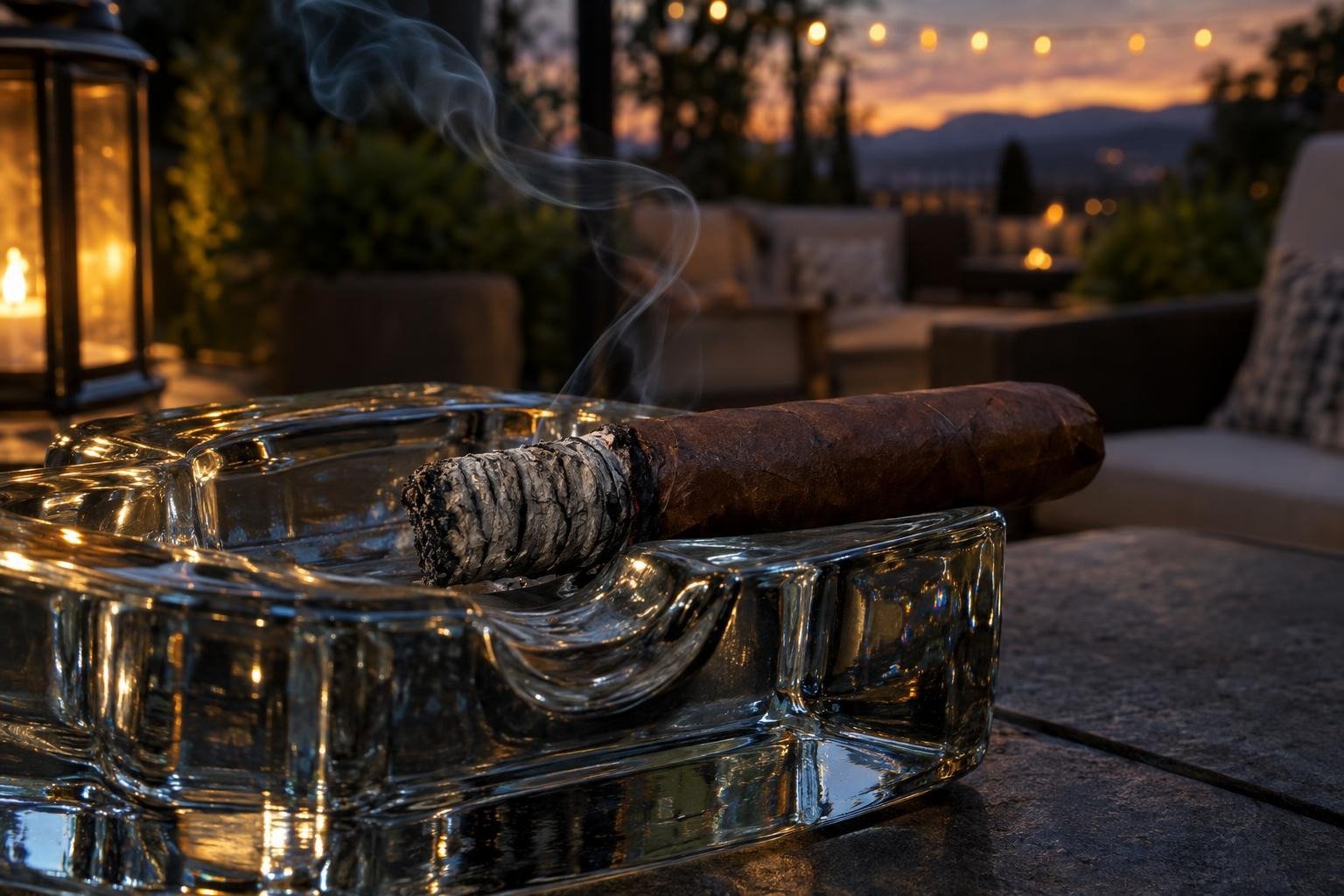
Splurge verdict: Buy good, not extravagant.
Here's where I pull back the reins a little. A great ashtray is a pleasure, but it's not a Tier One item. Still, a poorly designed one can ruin an evening just as surely as a bad cutter. Anyone who has watched a lit cigar roll off a tiny, shallow tray and onto a patio cushion understands that gravity does not take nights off.
What to look for:
Wide, deep cradles that can hold a cigar steady, even a big, fat one, without it tipping.
Weight. A heavy ashtray stays put in the wind. A light one becomes an impromptu frisbee.
Easy cleaning. Glass, ceramic, or stainless steel wipes down in seconds.
A shape that suits outdoor use. Deeper bowls catch ash in a breeze, and a wider footprint resists tipping.
Where the money goes: Weight, stability, and a smooth finish. You don't need a hand-carved masterpiece. You need something that holds a burning cigar like it means it.
6. The Travel Case (Supporting Player)
Splurge verdict: Mid-range. Buy something durable.
If you ever take a few cigars to a friend's porch, a camping trip, or a long drive, a travel case matters. A flimsy tube can crush your cigars or let them dry out in a matter of hours.
What to look for:
A rigid structure that won't flatten under pressure.
A tight, reliable seal to keep humidity in.
Some form of built-in humidification, even a small one.
A size that fits your usual cigars, with a little room to spare.
Where the money goes: Material and seal. Quality leather or a hard shell offers real protection. A soft, floppy case is essentially a decorative sleeve.
7. The Punch or V-Cut (Optional Blade Zone Add-On)
Splurge verdict: Optional, and a decent one is inexpensive.
A punch makes a small, neat hole in the cap, and a V-cut slices a wedge. Both can offer a more concentrated draw on certain cigars. Look for a sharp, clean-edged tool with a well-aligned blade. Simple tools don't need a big budget, but sharpness and a stable action still count.
8. Cedar Spills and a Backup Flame (Flame Zone Support)
Splurge verdict: Cheap, but don't skip them.
Cedar spills are thin strips of wood that you light with a match or lighter and then use to light your cigar. They add a lovely, mellow aroma and give you a gentle, controlled flame. They're also your plan B when your lighter decides to take a personal day.
Keep a small stack in the Oasis. A handful costs next to nothing and could salvage an entire evening. Pair them with a box of long matches and you've got a backup flame system that works in nearly any weather and requires zero batteries.
9. A Cigar Rest or Stand (Supporting Player)
Splurge verdict: Low-key, but worth a little thought.
When you want to set a cigar down for a moment, say, to examine the sky or retrieve a drink or debate whether that rustle in the bushes is a raccoon, you need somewhere that isn't the arm of a chair. A stable rest that keeps the cigar elevated protects your furniture and keeps the burn steady.
Look for something heavy enough to resist wind and shaped to cradle the cigar without pinching it. A simple, well-weighted rest does the job beautifully.
10. Backyard Comfort: The Environment Matters Too

I promised a quiet smoke in the peace of your own back yard, and the gear list wouldn't be complete without a few pieces that make the space itself worth lingering in. These aren't strictly cigar accessories, but they dramatically change the experience.
A real chair. Not a folding relic that pinches the back of your knees. Invest in a chair that supports you for an hour without making you think about your lumbar region. Comfort extends the evening.
A stable side table. It should be wide enough for an ashtray, a drink, and your cutter, and sturdy enough that a stray elbow doesn't trigger a small avalanche.
Wind control. A modest wind screen, a strategically placed planter, or even choosing the leeward side of the house makes a huge difference to both lighting and burn.
Ambient lighting. Warm, low light beats a harsh floodlight every time. Candle lanterns, string lights, or a small, dim lamp will make the Oasis feel like a place worth visiting, no raccoon-related pretext required.
Bug control and a good drink vessel. A quiet way to keep mosquitoes away, plus a heavy glass or insulated tumbler that doesn't blow over in a gust, round out the setup.
11. Maintenance Supplies (The Unsung Heroes)
Splurge verdict: Small purchases, big payoff.
Keep a small kit with distilled water and humidification solution, refined butane, a soft cloth for blades and ashtrays, and a small brush for clearing debris. It costs almost nothing, and it keeps the expensive gear performing like it did on day one.
Where to Save (Guilt-Free)
Now that I've told you where to spend, let me release you from the burden of spending everywhere. Here are the places where frugality is not just acceptable, it's wise:
Decorative extras. Engraved plates, themed lids, and novelty shapes cost a lot and add nothing to the smoke.
Oversized gift sets. See above. Pick pieces on their own merits.
Gadgets with batteries and an app that perform a task a simple, reliable tool does better.
Backup cutters. A cheap, spare cutter in the glove box is fine. It's an emergency tool, not a daily driver.
Cedar spills and matches. They are cheap by design. Embrace it.
Building Your Kit Without Overspending
If your budget is limited, build in layers:
A quality cutter and a reliable lighter first. They cover the Blade and Flame zones and improve every cigar immediately.
A solid humidor and a trustworthy hygrometer next. Once you keep more than a few cigars on hand, the Climate zone is essential.
An ashtray and a travel case after that. Mid-range quality is plenty.
Upgrade the environment over time. A better chair here, a nicer side table there. The Oasis grows as you do.
This spreads out the spending, puts the important pieces first, and lets your preferences sharpen along the way.
The Takeaway
At the end of the day, cigar accessories aren't about status. They're about respect: respect for the cigar, the craft behind it, and the quiet time you set aside to enjoy it. A great cutter, a dependable lighter, and a well-built humidor are the three pillars that support nearly everything else. Everything outside those pillars is a nice-to-have, a pleasant extra, or a very sturdy cup holder.
So the next time you're standing at a counter debating whether a piece of gear is worth the price, go back to the Three Zones. Does it touch the flame? Does it touch the blade? Does it protect the climate? If so, splurge with a clear conscience. If not, buy something sensible, save the difference, and put it toward the next great cigar.
As for me, the floodlight's motion sensor needs another thorough inspection. It's going to take a while. Possibly the length of a full cigar. Don't wait up.
Let's Keep the Conversation Going
If this post helped you rethink your gear, or if you've got a favorite piece of equipment you'd gladly defend in a courtroom, I'd love to hear about it. Come hang out with us:
Follow along on Instagram
Join the conversation on Facebook
Visit Beyond the Humidor for more cigar talk
Check out Brown's Life for more good living
Pull up a chair, light something worth savoring, and tell us what's in your kit.
